(Written by Jen VuHuong)
“Why didn’t they show up?”
It is one of the most common questions coaches ask after facilitating a corporate innovation programme.
The participants did not join.
The cameras stayed off.
The discussion felt flat.
Assignments were incomplete.
The coaches left wondering whether the programme had failed—or whether they had failed.
For many years, I also interpreted these moments mainly as coaching challenges.
Perhaps the participants lacked motivation.
Perhaps the questions were not powerful enough.
Perhaps the facilitation was not engaging enough.
Perhaps we needed more tools, more activities, or a different communication approach.
Today, after working with universities, startups, public organisations, and large corporations, I see these moments differently.
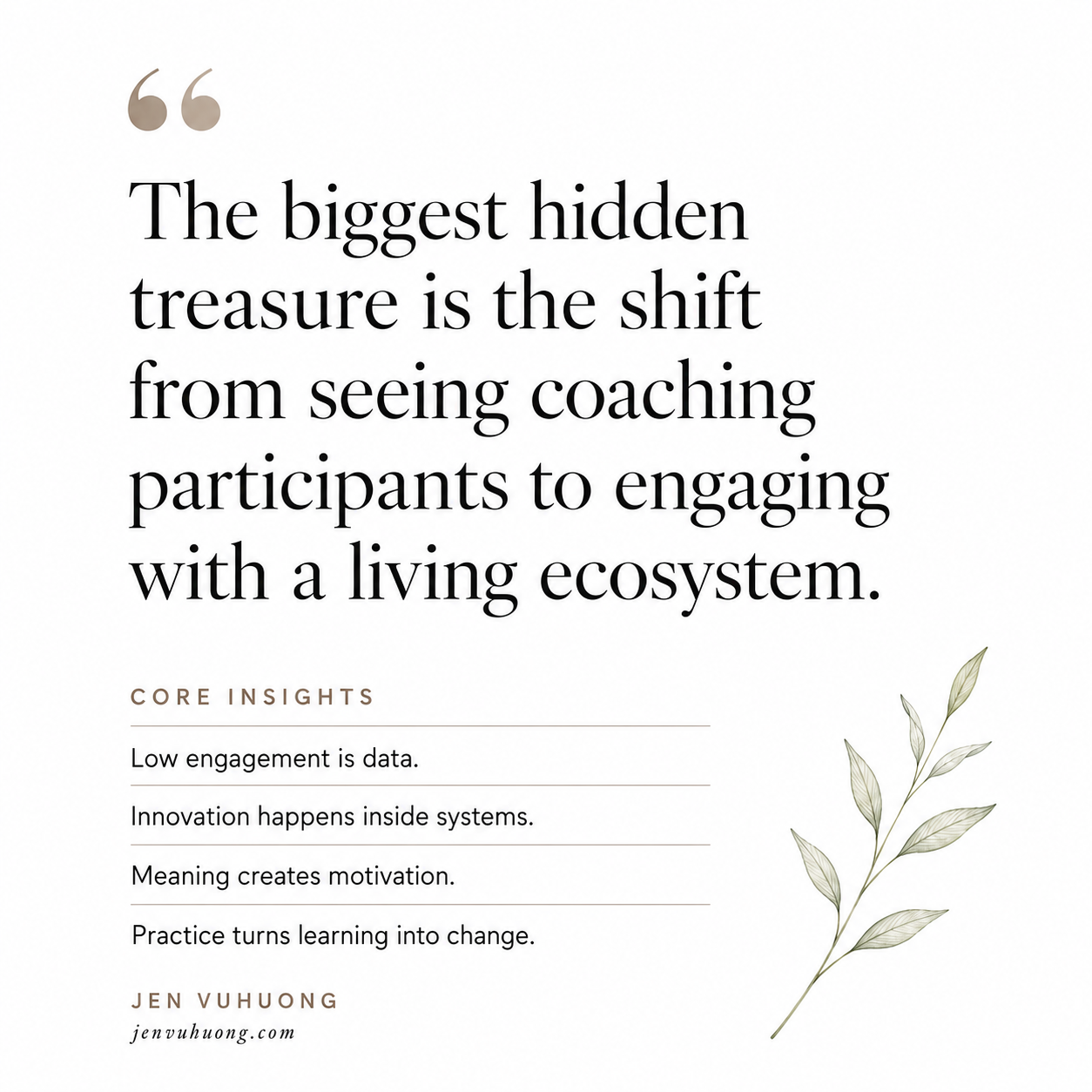
Low engagement is rarely only an individual problem.
It is often information about the wider system.
The most important shift for coaches supporting innovation is therefore not simply learning to coach individuals more effectively.
It is learning to see—and coach—the living system around them.
Innovation Happens Inside Systems
Innovation does not emerge because people attend a workshop.
It does not appear because they complete another online course, learn a new framework, or generate an impressive list of ideas.
Innovation emerges when people can connect:
their personal meaning;
their everyday work;
the people around them;
the organisation’s priorities;
and a real opportunity to create value.
When these elements connect, people are more likely to participate, experiment, and persist.
When they do not, engagement naturally weakens.
A participant may understand the innovation tools but have no authority to use them.
A team may generate ideas but receive no response from decision-makers.
A manager may publicly support innovation while privately prioritising immediate operational targets.
A programme sponsor may request transformation without changing any of the conditions that produced the current behaviour.
In these situations, attendance is only the visible symptom.
The deeper dynamics remain underneath.
Looking Beyond the Individual
Many coaching conversations begin with valuable questions such as:
“What do you want to achieve?”
“What is stopping you?”
“What action will you take?”
These questions can create clarity and movement.
But inside organisations, they are often incomplete.
An innovation coach also needs to ask:
What organisational pressures are shaping this person’s behaviour?
Who influences what they can decide or prioritise?
What does the system reward?
What does it quietly punish?
What happens when someone questions the existing way of working?
Does this person genuinely have permission to experiment?
What risks are they being asked to carry?
Who else must change for their action to become possible?
A participant may appear uncommitted when they are actually overloaded.
A manager may appear resistant when they are protecting delivery targets.
A team may appear passive because previous ideas disappeared into the organisation without explanation.
An employee may stay silent because the cost of speaking honestly feels greater than the value of participating.
The person in front of us is never operating alone.
Every individual is shaped by relationships, incentives, histories, routines, power, culture, and expectations.
To coach innovation well, we must learn to see the person and the system at the same time.
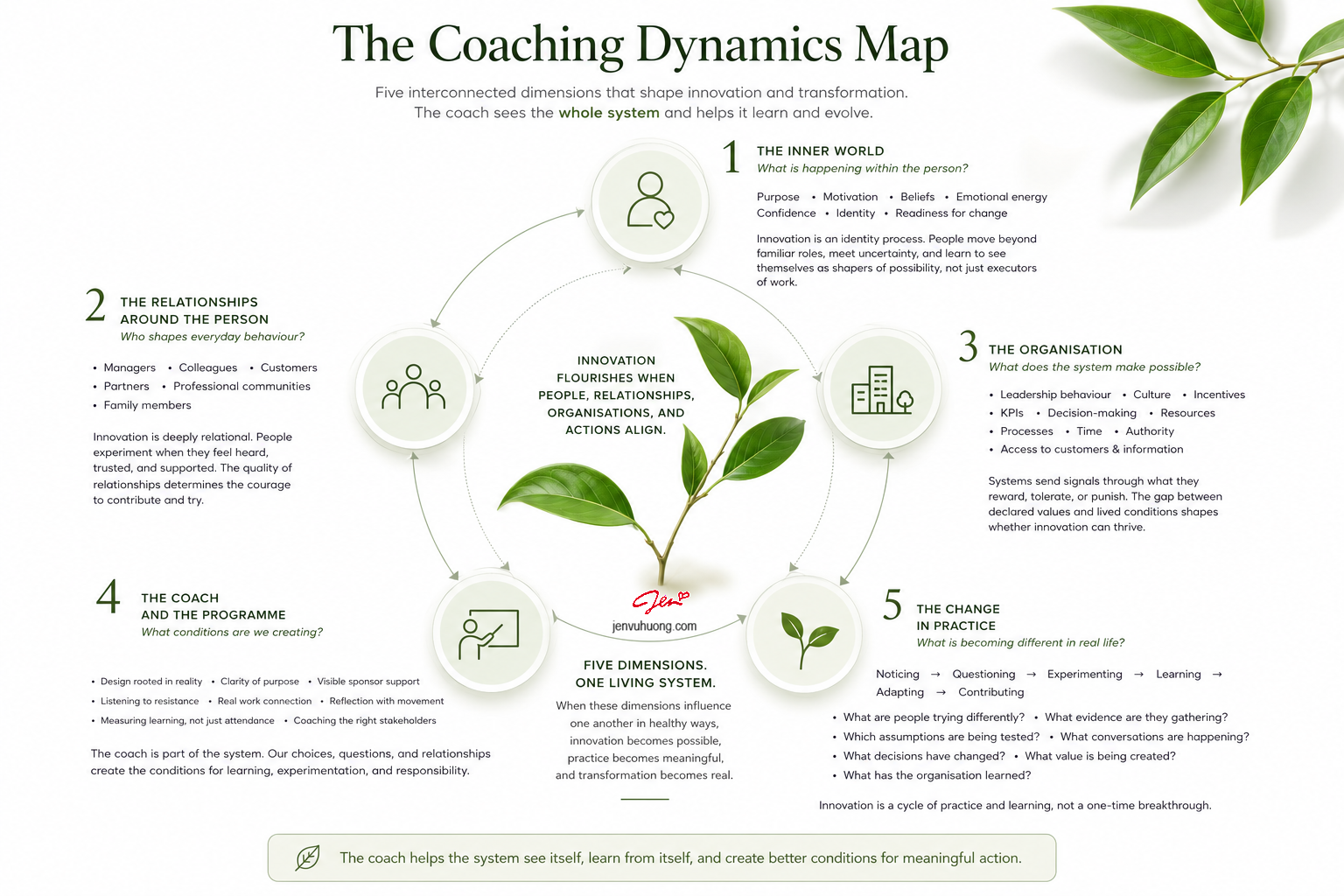
The Coaching Dynamics Map
When supporting innovation teams and programmes, I find it useful to scan five interconnected dimensions.
These dimensions are not separate boxes.
They continuously influence one another.
1. The Inner World
What is happening within the person?
This includes:
purpose;
motivation;
beliefs;
emotional energy;
confidence;
identity;
readiness for change.
Innovation often asks people to move beyond familiar roles.
An expert may need to become a beginner again.
A manager may need to admit uncertainty.
A team member may need to challenge an assumption held by someone more senior.
A participant may need to see themselves not only as someone who executes work, but as someone capable of shaping it.
This is why innovation is not only a technical process.
It is also an identity process.
People do not simply learn new methods.
They learn new ways of seeing themselves in relation to uncertainty, responsibility, creativity, and contribution.
2. The Relationships Around the Person
Who shapes everyday behaviour?
This may include:
managers;
colleagues;
customers;
partners;
professional communities;
family members.
Innovation is deeply relational.
People rarely experiment alone.
They need someone who will listen to an early idea.
Someone who will offer honest feedback.
Someone who will make an introduction.
Someone who will protect time.
Someone who will allow an imperfect first attempt.
A person may feel inspired during a coaching session and return immediately to a team that dismisses experimentation.
A participant may want to contribute but fear creating tension with a direct manager.
A founder may carry a bold vision but lack trusted relationships in which that vision can be tested.
Innovation coaches therefore need to notice not only individual capability, but also the quality of the relationships surrounding action.
3. The Organisation
What does the system make possible?
This includes:
leadership behaviour;
culture;
incentives;
KPIs;
decision-making;
resources;
processes;
time;
authority;
access to customers and information.
Organisations often say they value innovation while rewarding predictability, speed, compliance, and short-term delivery.
They may invite employees to think differently while requiring every decision to pass through the same structures that preserve the current way of working.
They may celebrate ideas but provide no pathway for testing them.
They may launch an innovation programme without clarifying what happens after the programme ends.
These contradictions are not minor implementation issues.
They shape whether people believe participation is meaningful.
A coach supporting innovation must therefore learn to recognise the gap between the organisation’s declared values and its lived conditions.
4. The Coach and the Programme
What conditions are we creating?
The coach is not outside the system.
Our presence, design choices, assumptions, language, and relationships also shape what becomes possible.
We need to ask:
Are we designing around the organisation’s reality or only our preferred methodology?
Do participants understand why the programme matters?
Are sponsors visibly involved?
Are we listening to resistance or trying to overcome it?
Are activities connected to real work?
Are we creating reflection without creating movement?
Are we measuring attendance rather than learning?
Are we coaching only participants when the sponsor or manager may need coaching too?
Sometimes the most useful intervention is a powerful question.
Sometimes it is redesigning the programme.
Sometimes it is helping a sponsor clarify the real purpose.
Sometimes it is bringing managers into the process.
Sometimes it is reducing the workload.
Sometimes it is pausing long enough to understand what the system is protecting.
The coach’s role is not merely to deliver a good session.
It is to create conditions in which learning, experimentation, and responsibility can become possible.
5. The Change in Practice
What is becoming different in real life?
The goal is not insight alone.
It is not even enthusiasm.
The goal is meaningful practice.
Innovation develops through cycles of:
noticing;
questioning;
experimenting;
learning;
adapting;
contributing.
A powerful workshop may create energy.
But sustainable innovation requires repeated action inside everyday work.
The important questions become:
What are people trying differently?
What evidence are they gathering?
Which assumptions are being tested?
What conversations are now happening?
What decisions have changed?
What value is being created?
What has the organisation learned?
Innovation is not a one-time breakthrough.
It is the capacity to keep learning in conditions of uncertainty.
Low Engagement Is Data
One lesson has continued to reshape my own coaching practice.
When participants do not engage, I no longer begin with:
“Why are they resistant?”
I begin with:
“What might the system be trying to tell us?”
Low participation may indicate:
unclear purpose;
competing priorities;
weak sponsorship;
lack of psychological safety;
insufficient authority;
programme overload;
previous disappointment;
little connection between learning and daily work.
It may also indicate that the programme was designed around assumptions rather than the lived reality of participants.
This does not mean coaches should avoid responsibility.
We still need to examine our design, facilitation, communication, and relationships.
But we should not immediately reduce disengagement to a weakness in the participant or a failure in ourselves.
Disengagement can be a form of organisational truth.
The empty chair may be telling us that the programme has not yet become meaningful enough to compete with the pressures of daily work.
The silent participant may be telling us that speaking honestly does not yet feel safe.
The incomplete assignment may be telling us that innovation has been added on top of everything else rather than integrated into the work itself.
When we learn to read these signals, engagement becomes more than a participation metric.
It becomes diagnostic information about the system.
From Capability to Commitment
Many corporate programmes begin with capability building.
Knowledge.
Skills.
Tools.
Frameworks.
These matter.
People need methods for understanding customers, generating ideas, testing assumptions, working collaboratively, and learning from evidence.
But capability alone does not produce innovation.
A person may know exactly how to run an experiment and still choose not to do it.
Why?
Because sustainable innovation begins before capability.
It begins with meaning.
When people understand why something matters, they are more likely to invest attention.
When meaning connects with personal responsibility, motivation grows.
When people believe their contribution can influence something real, ownership develops.
When ownership is supported by permission, relationships, and structure, practice becomes possible.
The movement is therefore not simply:
Knowledge → Action
It is more often:
Meaning
→ Motivation
→ Ownership
→ Permission
→ Practice
→ Capability in action
People do not protect time merely for activities.
They protect time for what they believe matters—and for what the system allows them to treat as meaningful.
The Coach as a Steward of Learning Systems
As coaching continues to evolve, especially in an age of artificial intelligence and accelerating change, I believe our role is expanding.
We are no longer only facilitators of individual reflection.
We are increasingly becoming stewards of learning systems.
A steward does not control the whole system.
Nor do they carry responsibility for every outcome.
They notice what is connected.
They protect the conditions needed for growth.
They help people see patterns that are difficult to see from inside their own roles.
They connect conversations that are happening separately.
They help sponsors, leaders, teams, and individuals understand their shared responsibility for change.
In practice, this may mean holding together:
individual identity and motivation;
team relationships;
organisational realities;
customer and stakeholder needs;
business and social outcomes;
long-term cultural learning.
This requires more than coaching competence alone.
Innovation coaches also need:
systems thinking;
organisational awareness;
innovation literacy;
ethical sensitivity;
stakeholder understanding;
the capacity to work with power and uncertainty.
The goal is not to become an expert in everything.
It is to become capable of seeing enough of the whole to know where a meaningful intervention may begin.
Five Invisible Threads Every Innovation Coach Weaves
Every meaningful innovation programme is strengthened by five invisible threads.
1. Purpose
Why does this matter?
People need to understand:
why the work matters now;
what problem it addresses;
who may benefit;
how it connects to their role;
what meaningful future it may help create.
Purpose should not remain an inspiring statement on the opening slide.
It needs to become visible in decisions, priorities, and daily work.
2. Permission
Are people genuinely allowed to act?
Permission is more than a verbal invitation.
People need to know:
what they may question;
what they may change;
what resources they can access;
what decisions they can make;
what happens if an experiment does not succeed.
An organisation cannot invite innovation while punishing every departure from certainty.
3. Psychological Safety
Is it safe to learn publicly?
Innovation requires people to:
admit that they do not know;
share incomplete ideas;
ask difficult questions;
challenge existing assumptions;
learn from mistakes.
Psychological safety does not mean comfort at all times.
It means people can participate honestly without unnecessary humiliation, retaliation, or exclusion.
4. Participation
Are people shaping the work or merely receiving it?
Real participation means people can:
contribute knowledge;
influence direction;
test ideas;
make decisions;
see how their input affects what happens next.
Attendance is not participation.
Speaking is not always participation.
Participation becomes meaningful when people experience agency and responsibility.
5. Practice
Is learning entering everyday work?
Without practice, even an excellent programme becomes another memorable but temporary event.
Practice requires:
real problems;
small experiments;
regular reflection;
feedback;
visible learning;
time to adapt.
The measure of an innovation programme is not only what people understood during the session.
It is what they continue doing differently afterwards.
Practical Questions for Innovation Coaches
Before, during, and after a programme, innovation coaches can ask:
About Meaning
Why does this programme matter to participants now?
What real problem are they trying to solve?
How does the work connect with customers, communities, or organisational priorities?
About Permission
What are participants genuinely authorised to change?
Who must approve experiments?
What happens when an idea challenges existing routines?
About Relationships
Which managers or sponsors influence participation?
Who supports experimentation?
Where is trust missing?
About Practice
What small action can happen inside real work?
What evidence will participants gather?
How will learning be reviewed and used?
About the System
What is the current behaviour protecting?
Which organisational tension is being expressed through disengagement?
Who else needs to be part of the coaching conversation?
These questions help the coach move from:
“How do I make participants engage?”
towards:
“What conditions would make meaningful participation possible?”
The Future of Innovation Coaching
Artificial intelligence will increasingly support:
knowledge acquisition;
content creation;
research;
pattern analysis;
programme preparation;
reflection prompts;
aspects of coaching administration.
These capabilities will change how innovation programmes are designed and delivered.
But tools alone cannot determine what a silence means.
A dashboard may show that attendance declined.
It cannot fully understand whether people feel unsafe, overloaded, unconvinced, unheard, or disconnected from the purpose.
AI may identify patterns in data.
Human coaches still need to engage ethically with the lived experience behind those patterns.
What will remain deeply human is our ability to:
sense what has not yet been said;
build trust before demanding action;
hold uncertainty without rushing to simplify it;
connect purpose with performance;
notice the relationship between identity and behaviour;
help people see themselves as participants in a larger living system.
The future of coaching may not be defined only by asking better questions.
It may be defined by seeing more deeply.
Seeing the individual.
Seeing the relationships.
Seeing the structures.
Seeing the contradictions.
Seeing the possibilities that may emerge when these elements begin to move together.
Because the greatest innovation rarely begins with a new idea.
It begins with a new way of seeing the system that gives ideas permission to live.
The biggest mistake in corporate innovation coaching is believing that we are coaching only the participants. In reality, we are engaging with a living ecosystem—and helping that ecosystem learn how to learn.
Jen VuHuong
EMCC Senior Practitioner; Co-Founder, Leadership Innovation Coaching Academy (LICA);
Program Founding & Director, S-Growth Innovation Coaching (SIC)
🌿 Building human, innovation, and business ecosystems where people and organisations can grow together.