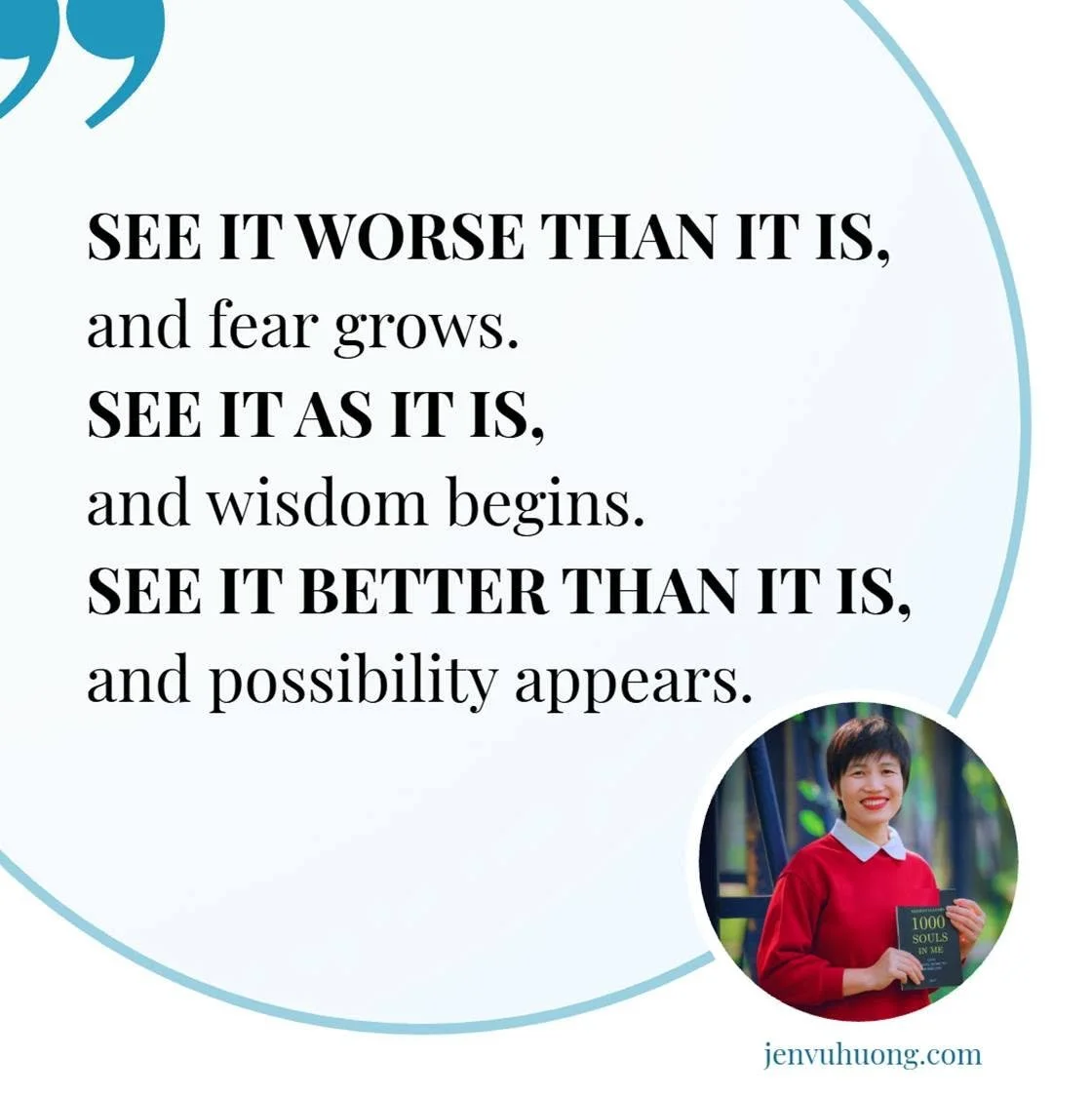
SEE IT WORSE THAN IT IS. SEE IT AS IT IS. SEE IT BETTER THAN IT IS.
We often hear:
“When we change the way we look at things, the things we look at change.”
And even when the situation does not change immediately, something in us already has.
In a recent coaching conversation, a senior leader said:
“I want to support one of my team members.”
The young employee had been under constant stress.
Her performance had been declining for three or four months.
Each conversation with her manager felt like another criticism.
Gradually, she stopped believing she could improve.
She was not only struggling.
She had started accepting suffering as normal.
So I asked the leader:
“Who do you really want to help?”
She replied:
“The team member.”
I asked:
“Why does this matter so much to you?”
She paused.
“I don’t want to see her become like this.”
Then I asked:
“How do you see her situation?”
She smiled.
“Like a cloud.”
“And when you were younger?”
She said:
“I would have seen it as the whole sky.”
That answer changed the conversation.
There are at least three ways we can see the same situation.
1. We can see it worse than it is.
A single cloud becomes the whole sky.
One criticism becomes:
“I am not good enough.”
One mistake becomes:
“I always fail.”
One difficult season becomes:
“My whole career is falling apart.”
Sometimes people are not only overwhelmed by what is happening.
They are overwhelmed by the meaning their mind has attached to it.
2. We can see it exactly as it is.
There is stress.
Performance has declined.
Trust in the working relationship has weakened.
The situation needs attention.
These are facts.
Nothing more.
Nothing less.
Seeing reality clearly is already an act of leadership.
Because clarity creates space.
And space makes wiser action possible.
3. Or we can see it better than it is.
Not by pretending everything is fine.
Not by avoiding difficult conversations.
Not through forced positivity.
But by remembering that today’s reality is not the whole story.
There is still potential.
There is still capacity that may not yet be visible.
There are conversations that have not happened.
There is support that has not yet been offered.
There may be assumptions on both sides that have never been examined.
And there is still a human being behind the performance.
Seeing it better than it is does not deny reality.
It expands reality.
As we continued, another layer appeared.
The leader had spoken several times with the team member.
But she had not yet spoken with the more senior leader.
She wanted to help.
Yet she had not fully stepped into the role of a bridge.
This is the quiet complexity of leadership when you are sitting between team members and more senior leaders.
You can see the pressure from both sides.
You understand the person who is struggling.
You also understand the expectations coming from above.
And sometimes you feel responsible for holding the whole space together.
But leadership is not always about choosing a side.
Sometimes leadership is becoming the space where truth can be heard without humiliation, where accountability can exist without fear, and where understanding can begin without excusing what needs to change.
Before creating that conversation, the leader also needed to look inward.
What emotions was she carrying toward the more senior leader?
What judgments had already formed?
What assumptions was she making about intention?
Was she entering the conversation to understand?
Or to prove that one person was right and another was wrong?
Because the quality of the conversation we create between others is always limited by the quality of the conversation we have within ourselves.
This is something I continue learning in leadership.
We rarely suffer only because of what happens.
We also suffer because of how we see what happens.
See it worse than it is—
and fear grows.
See it exactly as it is—
and wisdom begins.
See it better than it is—
and possibility appears.
The situation may not change immediately.
The people involved may still need difficult conversations.
Performance may still need to improve.
Accountability may still be required.
But the person looking at the situation has already changed.
And often, that is where transformation quietly begins.
❤ Reflection Corner
Where in your leadership are you currently seeing one cloud as the whole sky?
And what might become possible if you could see the situation clearly—without making it smaller, and without making it heavier than it is?
With love and gratitude,
Jen 🌿