What story are you feeding in your life or leadership right now? Survivor or Sovereignty
Last week, I met an ecosystem builder who has been supporting Vietnam for many years.
In the middle of our conversation, he said something that stayed with me:
“This year, I am listening to so many languages of survival.”
That sentence entered me quietly, but it did not leave.
Because it is happening.
So many brilliant people are still speaking from survival.
So many leaders are still building from survival.
So many founders, educators, coaches, mothers, fathers, team leaders, and changemakers are still carrying the frequency of survival even while talking about vision, growth, impact, and innovation.
The words may sound strategic.
The plans may look ambitious.
The mission may be beautiful.
But underneath, the field still says:
I must hold everything together
I cannot rest yet
I must prove my worth
I have to keep saving this
I will deal with myself later
I just need to get through this month
I can survive one more threshold
This is what I call survivor leadership.
And many of us have been rewarded for it.
Survivor leadership can look impressive from the outside.
It creates movement.
It can create results.
It can even create admiration.
Because the survivor is strong.
The survivor knows how to:
endure
adapt
recover
keep going
carry pain quietly
move even when there is very little left
But there is a cost.
Survivor leadership can build momentum, yet it rarely builds peace.
It can carry a mission, yet it often cannot carry sustainability.
It can rescue others, yet it quietly abandons the self.
And after enough years, a leader begins to feel the deeper truth:
I do not want to build the future from the same frequency that I once used to merely stay alive.
That is the threshold.
That is where leadership begins to mature.
What is the story of survivor leadership?
Survivor leadership is not weakness.
It is often the strength that was born too early.
It is the kind of leadership formed through:
instability
emotional burden
financial pressure
family responsibility
institutional rigidity
repeated crisis
the need to become strong before one was fully held
It is leadership that says:
I will carry this.
I will make it work.
I will survive.
I will keep everyone okay.
I will hold the field, even if I disappear inside it.
For a season, this leadership may be necessary.
For a season, it may even be noble.
But it is not the final form.
Because if a leader stays too long in survivor mode, several things happen:
1. Urgency becomes identity
The person no longer only experiences crisis.
They begin to organize life around crisis.
2. Over-functioning replaces clarity
They speak too much, explain too much, help too much, carry too much.
3. Threshold becomes familiar
Living close to the edge starts to feel normal.
4. Help becomes entanglement
Care quietly turns into carrying.
5. Vision becomes disconnected from structure
The soul sees very far, but daily reality keeps returning to instability.
This is the story of survival.
And this story is everywhere.
It is in organizations.
It is in communities.
It is in families.
It is in nations trying to move forward while still speaking from old wounds.
It is in changemakers who want to heal the world but have not yet built the floor beneath their own feet.
What is the story of sovereignty leadership?
Sovereignty leadership is not domination.
It is not hardness.
It is not emotional distance.
Sovereignty leadership is the moment a leader says:
I will no longer use emergency as my operating system.
It is the shift from:
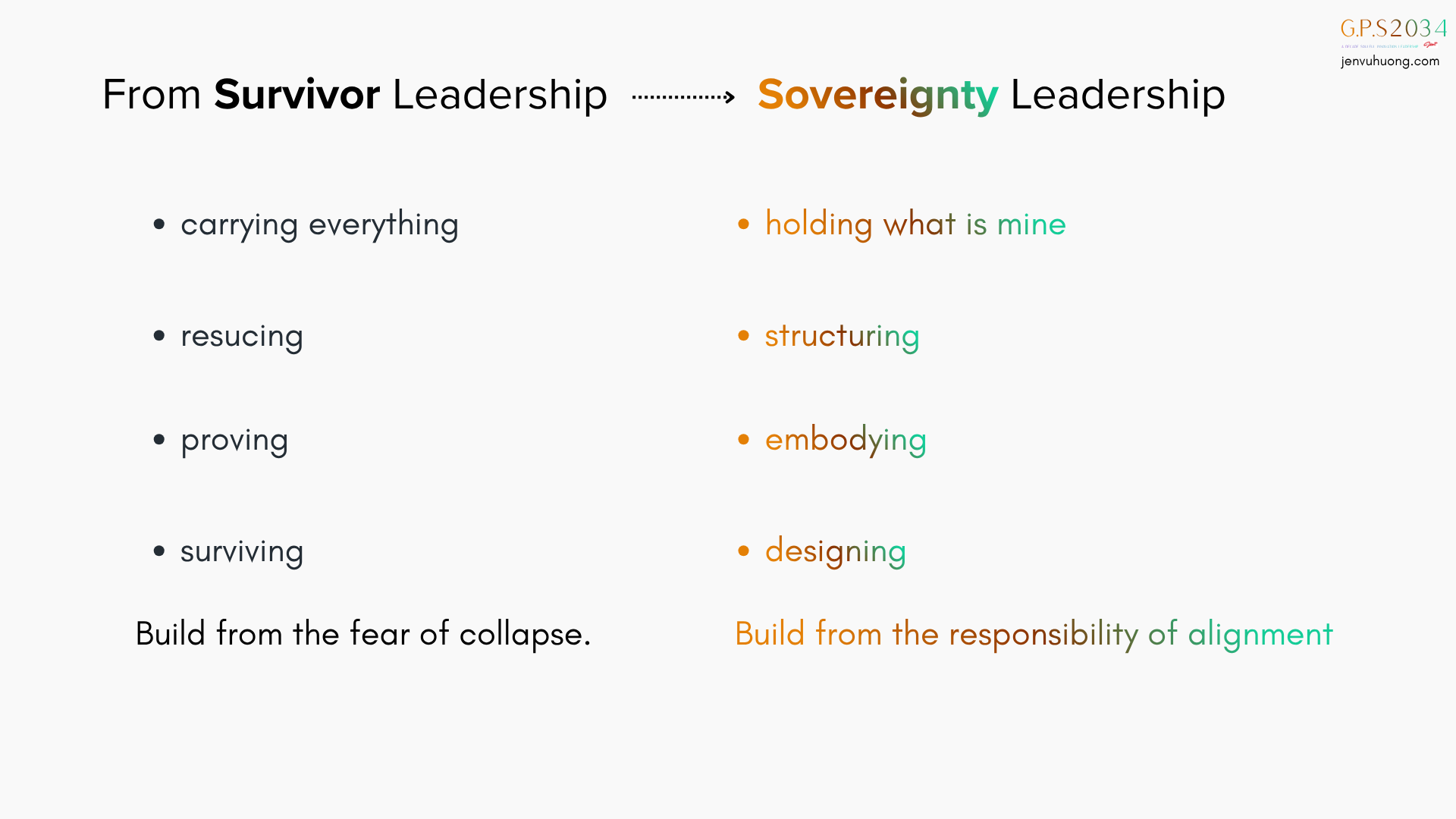
carrying everything → holding what is mine
over-giving → contribution with clarity
saving → structuring
proving → embodying
surviving → designing
Sovereignty leadership does not deny pain.
It integrates it.
It does not deny responsibility.
It clarifies it.
It does not become cold.
It becomes clean.
A sovereign leader can still feel deeply.
Can still care deeply.
Can still support deeply.
But from a different place.
Not from depletion.
Not from fear.
Not from the unconscious belief that love must cost the self.
Sovereignty leadership says:
I support myself first so I can support others cleanly
I do not confuse compassion with self-erasure
I do not need crisis to activate my power
I do not build my life around the edge anymore
I let truth arrive earlier
I let structure hold what mission alone cannot
This is not smaller leadership.
This is more mature leadership.
Why this matters now
Because many of us are no longer in the phase where surviving is the lesson.
The lesson now is:
stability
embodiment
clean receiving
healthy boundaries
sustainable contribution
reality aligned with vision
Some of us have already proven that we can survive.
We have survived enough.
The next chapter is not another heroic threshold.
The next chapter is quieter and more radical:
to create a life where our gifts no longer depend on our suffering to become visible.
This matters personally.
It also matters collectively.
If we want stronger communities, stronger ventures, stronger nations, stronger ecosystems, we cannot continue normalizing leader exhaustion as leadership maturity.
We cannot keep celebrating sacrifice while ignoring structure.
We cannot keep praising resilience while neglecting sustainability.
At some point, the new future requires a new nervous system.
A new money relationship.
A new relationship to responsibility.
A new language.
The language must change first
Every reality is reinforced by language.
If the inner language remains survival-based, the outer structure will keep echoing it.
When a person says:
“I just have to get through this”
“I’ll deal with myself later”
“I can carry this too”
“it’s okay, I don’t need much”
“I’ll figure it out at the edge”
“I can survive one more time”
They are not just describing reality.
They are feeding it.
That is why change begins in language.
New language does not mean false positivity.
It means cleaner truth.
For example:
Instead of:
I have to hold everything.
Try:
I will hold what is truly mine.
Instead of:
I’ll help everyone first.
Try:
I will support myself so what I give is sustainable.
Instead of:
I always survive.
Try:
I now build so I do not need to live at the threshold.
Instead of:
something will work out.
Try:
I will create one clear path and follow it consistently.
This is how story changes.
And when story changes deeply enough, behavior changes.
And when behavior changes long enough, reality catches up.
Let reality catch up
This story matters.
Because many visionaries live ahead of their reality.
They see farther than what is materially built.
They feel the future before the system is ready to hold it.
That is a gift.
But it can also become a trap.
If we live only in future vision without changing daily structure, reality cannot catch up.
So the invitation is not to dream smaller.
It is to become more embodied.
To ask:
What does sovereignty look like in my money?
What does sovereignty look like in my schedule?
What does sovereignty look like in my leadership language?
What does sovereignty look like in what I stop carrying?
What does sovereignty look like in how I receive?
This is where future identity becomes present practice.
The real shift
From survivor leadership to sovereignty leadership, the deepest shift is this:
I no longer build from the fear of collapse.
I build from the responsibility of alignment.
This means:
less drama
less proving
fewer thresholds
more honesty
more design
more self-support
more disciplined compassion
It means the leader no longer asks:
“How much can I endure?”
The leader now asks:
“What kind of life, business, team, and reality am I building if I refuse to keep normalizing survival?”
That question changes everything.
For the leader reading this
If you feel tired in a way that success has not fixed,
if you feel strong but not peaceful,
if you feel visionary but still structurally unstable,
if you feel deeply caring but secretly overburdened,
if you keep returning to the same emotional or financial threshold,
then perhaps your next evolution is not more resilience.
Perhaps it is sovereignty.
Perhaps life is not asking you to become harder.
Perhaps life is asking you to become cleaner.
Cleaner in truth.
Cleaner in money.
Cleaner in boundaries.
Cleaner in what is yours and what is not.
Cleaner in what you are building and what you are still unconsciously repeating.
You do not need to stop being compassionate.
You do not need to stop helping.
You do not need to stop leading.
You simply need to stop leading from the wound that once taught you how to survive.
Because that version of you deserves rest now.
And the next version of you deserves structure.
A new story
So yes, let us change the story.
Not with slogans.
Not with bypassing.
Not with fantasy.
But with deeper honesty.
Let us stop romanticizing exhaustion.
Let us stop confusing sacrifice with leadership.
Let us stop turning recurring instability into identity.
Let us create a different language.
A language where:
leaders are allowed to be supported
empaths are allowed to have boundaries
changemakers are allowed to receive
founders are allowed to build without burning through themselves
compassion and discipline belong together
soul and structure are not enemies
This is the leadership that creates infinite flow of abundance, sustainablity and joy.